The Marketer’s Guide to AI-Powered, Human-Centric Content
AI has been the talk of the industry this past year, and the noise is only getting louder on both sides of the aisle. On one hand, people are convinced artificial intelligence is here to replace creatives and strip the humanity from every piece of work. On the other, it’s being waved around like a magic wand that will fix every marketing workflow overnight.
I’ve spent the past couple of months feeling both sides as a marketer and content strategist, and one thing is abundantly clear: the next era of marketing is about collaboration: human strategy + AI execution.
Personally, I’ve been tinkering with different tools, experimenting with prompts to see what works and what doesn’t. Collaborating with AI as a thought partner or first-draft companion takes me to the finish line faster than ever before. I’ve taken courses and certifications from the University of Maryland, Databricks, and Hubspot to understand AI-powered marketing more deeply.
With all of this, I’m learning quickly that when you combine strategy-driven prompting with story-centric content frameworks, marketers can create conversion-driven content that feels alive, authentic, and distinctly human.
Here’s a marketer’s guide to AI-powered, human-centric content creation:
Why AI Isn’t Here to Replace Marketers
I remember the first time I used ChatGPT for marketing, I was shocked at how poor the outputs were. A simple one-sentence prompt would spit out blogs or social posts that sounded stiff, robotic, and just… off. Even after several iterations of “make it sound more Gen Z” or “refine this based on the company’s mission,” the copy still fell flat. Honestly, as a writer, it felt validating: good copy was always going to live in human hands.
Fast forward, and I’ve learned that collaboration is the name of the game. AI isn’t here to replace marketers; it’s a tool that amplifies what we already do best. Human judgment, context, and creativity still drive results. In fact, both professionals and academics in the University of Maryland AI & Career Empowerment certification highlighted that one of the biggest misconceptions is that artificial intelligence will replace jobs, especially in marketing and creative fields. The reality is that AI in marketing can streamline workflows, generate insights, and identify patterns, freeing marketers from tedious tasks so we can focus on strategy, analysis, and creative problem-solving.
Now, I use AI to draft content plans, compare strategies, and stress-test insights that I gather from client data and conversations. AI is integrated into my frameworks to produce faster outputs, but I’m still there, refining, adding cultural nuance, trends, and that human touch that makes content resonate.

The 5 Essentials of AI Prompting for Marketers
I’ve been developing prompt engineering intuition for months; I just didn’t have the language for it until now. After finishing a couple more certifications (Databricks Generative AI Fundamentals and a HubSpot Academy AI for Marketing Course), I can finally articulate what makes a great marketing prompt, and why some outputs feel “almost there” while others feel unusable.
Here are the 5 elements I believe every strong marketing AI prompt needs:
1. Define the Role
Defining the role is all about telling AI who it’s speaking as and who it’s speaking to. Be specific and include client mission, values, target audience, top-selling products, and even anecdotal sales insights. I use client onboarding materials, brand books, and past meeting notes to set the tone.
Pro tip: Create a detailed profile in ChatGPT for each client, product, or service you’re working with. This will store memory in conversation threads and ensure consistency across outputs as you continue to build out your content marketing plan.
2. Specify the Result
AI can’t hit a target you don’t define. Be crystal clear about what you’re expecting, whether it’s a LinkedIn post, blog outline, meta description, or campaign copy. Add specific attributes like “SEO strong,” “Gen Z voice,” or “conversion-focused” to guide the output.
For example, “Create an SEO-strong blog outline for a 1000-1500 word blog about [topic]” is a prompt I use frequently. This produces something you can refine with client-specific context. Being explicit about the result prevents wasted iterations and keeps AI outputs aligned with your marketing goals, ensuring every piece of content has a purpose and measurable impact.
3. Provide the Context
Context gives AI the canvas it needs to generate relevant outputs. Include the topic, format, and/or structure. For instance, are you explaining terpenes for beginner cannabis consumers or outlining a business pain point for executives? I often layer in personal copywriting frameworks, like my 5-Step Pain Point Framework (see more below) or more popular frameworks like AIDA (Attention, Interest, Desire, Action) or PAS (Problem, Agitation, Solution), to guide outputs.
Context ensures AI produces content that resonates with your audience and fits seamlessly into your strategy. The richer your context, the closer the AI’s first draft is to a polished, human-ready piece.
4. Explain the Intent
Intent anchors the AI output to a measurable goal: drive traffic, generate leads, educate, or spark engagement. A social caption meant to drive clicks will read differently from one meant to encourage conversation. Clearly stating intent helps AI tailor the tone, structure, and call-to-action for the desired outcome. Without intent, even well-written content risks falling flat with your audience or your KPIs.
5. Include the Constraint
Define the limits of your output, such as word count, brand tone, formatting rules, or prohibited styles. Clear constraints save editing time and keep outputs on-brand.
Channel requirements like character or word counts are an obvious constraint. However, you may have other guidelines to help refine AI outputs closer to final drafts. For instance, you may ask AI to make sure there are no em dashes or contrast framing to help maintain a human voice. Your brand voice or industry may have certain restrictions, such as not explicitly saying “cannabis” on social media posts.
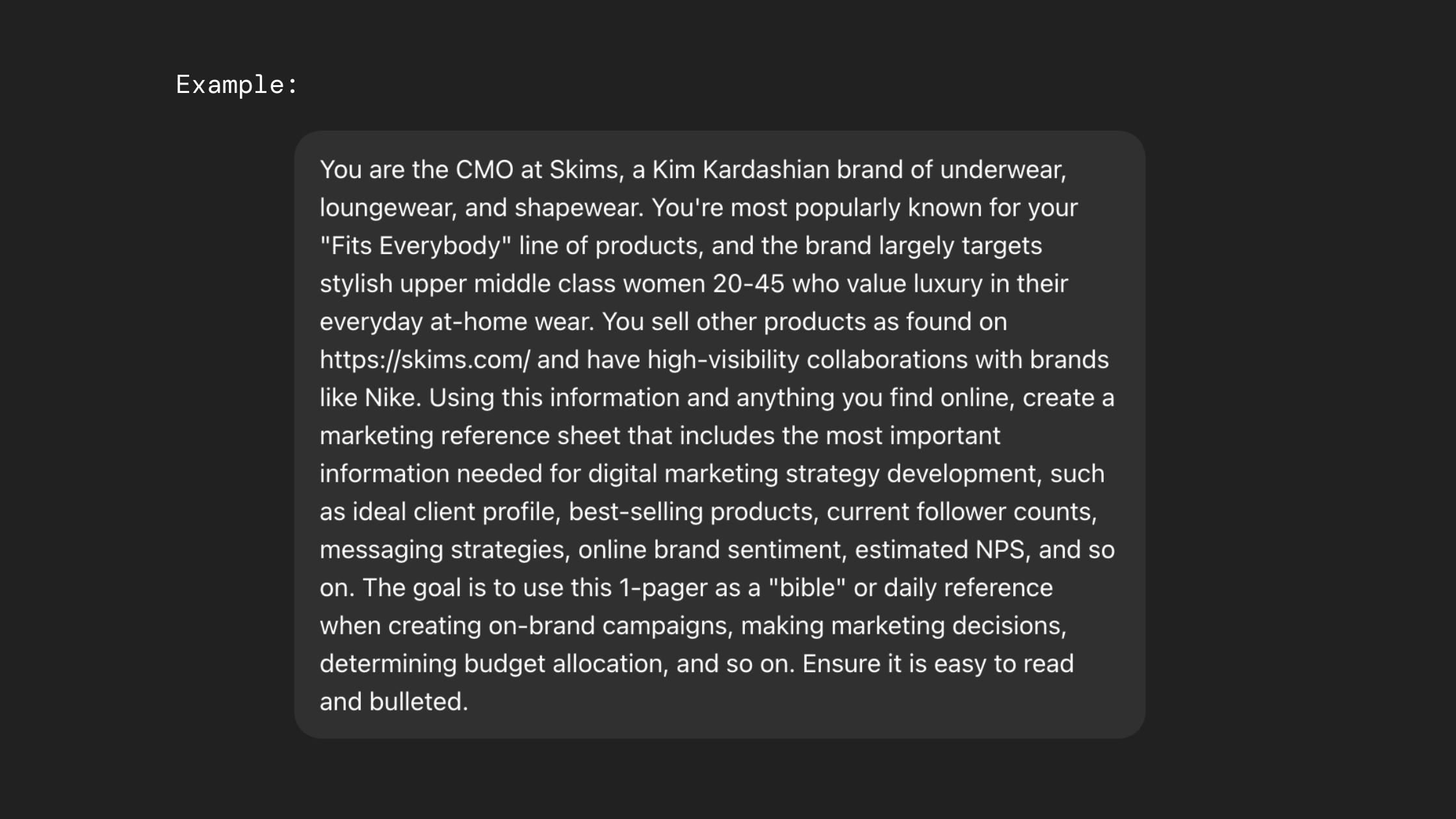
By including these constraints, you can focus on cultural nuance and creative touches rather than correcting basic formatting or tone.
When you combine these five elements, you get AI outputs that are closer to the finish line, easier to humanize, and aligned with real marketing strategy.
And honestly? Some of my strongest outputs come from prompts that took longer to write than the content itself. That’s the point. AI doesn’t replace the craft; it accelerates it.
Using the 5-Step Pain Point Framework With AI
Copywriting frameworks like AIDA and PAS provide a structured approach to crafting persuasive marketing messages. They help marketers improve conversion rates across content-based campaigns. By following these frameworks, brands can consistently produce clear, engaging, and goal-oriented content, and when combined with AI, they provide the context needed for higher-quality outputs that align with your marketing strategy and offer.
Here’s the “Pain Point Framework” I’ve created specifically for B2B brands looking for conversion-driven content. You can, of course, tailor it to your D2C brand or change the intent to engagement or awareness, as needed.
1. Paint the Pain Point
Start by clearly defining the audience’s current reality. Illustrate specific struggles, like wasted time, lost revenue, or missed leads, and connect with readers’ pain to show that you understand where they are.
Example: “You’re spending hours down the YouTube tutorial rabbit hole trying to figure out how to create compliant and effective marketing for your dispensary - all while trying to run a business.”
2. Call Out the Problem
Next, identify the root cause behind your audience’s pain. Highlight the patterns or obstacles, like lack of clarity, overwhelm, or misallocated resources, that are holding them back.
Example: “You’re throwing spaghetti at the wall while blindfolded - there’s no strategy, and you can’t tell what’s sticking.”
3. Introduce the Solution
Offer a clear, high-level solution to the problem your audience is facing. It’s not time for your pitch yet; this is meant to show your audience that they can address the root cause and improve their current reality. Keep it concise, actionable, and easy to grasp.
Example: “What you need is a marketing program that’s tailored to actually driving results that matter for your business: more orders, higher order value, and repeat customers.”
4. Serve Yourself as the Ideal Solution
Now, it’s time to go in for the kill. Show why your team, service, or product is the best fit to deliver the exact solution you were talking about. Highlight your unique expertise, approach, or offering that directly addresses the audience’s pain point, and why it’s the most effective choice for their specific situation. Keep it confident but relatable.
Example: “Our Dispensary Boost Package does exactly that. At our agency, we’ve worked with hundreds of dispensaries around the country and developed a unique solution designed specifically for established dispensaries. The Boost Package combines SEO, PPC, and CRM to build a marketing program that gives you concrete numbers like new customers, average order value, loyalty members, and ROI to report back to your higher-ups and investors.”
5. Emphasize the Transformation
Highlight the new reality your solution creates. Show how life, work, or results improve compared to the initial pain point, painting a vivid picture of the benefits and positive outcomes your audience can expect. End with a clear nudge toward the next action.
Example: “You can finally close that window with 31 tabs on cannabis marketing and free up all that time you’ve been using trying to figure things out yourself. With our award-winning team, you can focus on running your business and your team while we handle your marketing. Book a FREE consultation to get started.”
STEAL THIS PROMPT
Copy-paste this into your AI tool next time you’re creating content.
“You are [role] with expertise in [domain/industry]. Using the Pain Point Framework below, create a [result] for [platform/context] that targets [audience/intent] and focuses on [topic/context]. Write the final content in [desired format/style], keeping it [constraint].
Pain Point Framework: 1) Current Reality: Describe the audience’s current experience with this pain point, highlighting the challenges and frustrations without mentioning my solution. 2) The Problem: Call out the root problem in clear, relatable, and specific terms. Make the pain tangible. 3) High-Level Solution: Introduce the solution in a concise, compelling way without going into too much detail. 4) Why Me/USP: Explain why I am the best provider of this solution, emphasizing unique selling points and credibility. 5) Transformation: Highlight the positive transformation the audience will experience by using my solution, focusing on emotions, outcomes, and aspirational results.”
Combining Both Frameworks for Maximum Impact
Combining both the five marketing AI prompt essentials and the five-step copy framework (what I like to call the “5x5 Method”) lets you structure AI prompts in a customer-first way. This approach gives you conversion-optimized content for your marketing channels and collateral.
You can use a customized copy framework or another standard version of your liking based on your unique offer. Then, you can refine AI drafts and create a final output that’s culturally aware, strategically aligned, and human at its core. By keeping your brand voice intact while scaling conversion-driven content creation, AI-powered content marketing lets you generate more, faster, without losing the nuance that actually connects with your audience.
Practical Tips for Marketers Using AI Today
Above all, start experimenting! Don’t wait for perfect outputs or models; play with free and accessible tools like ChatGPT, Claude, and Gemini to get your feet wet. If you have access to Microsoft or Google suites through work or school, Copilot and Gemini Pro are great options too.
For marketing-specific tools, Jasper and Copy.ai are worth trying. Jasper has a 7-day free trial and then $59/mo, while Copy.ai is $29/mo at the time of this writing. Other helpful tools like Grammarly, ClickUp, Notion, and Canva integrate AI features directly into their platforms, making productivity and content creation smoother.
The key? Keep humans in the loop. Whether you work solo or with a team, oversight, cultural nuance, and client specificity are what make AI outputs truly effective. Test different tools to see what works for your niche or unique operating process.
In my personal content marketing workflow, AI saves hours on blogs, website copy, landing pages, and social posts, but it’s my edits, refinements, and strategic touch that elevate the work to a level our clients and executives love and can actually measure with results.
A practical tip we follow at Cannabis Creative: keep AI-generated content under a threshold you’re comfortable with; ours hovers around 20-30%, though AI detectors aren’t perfect, it helps maintain that human edge.
Final Thoughts on AI & Marketing
The power is in your hands as a marketer. It’s not too late to become one of the first experts in AI-driven marketing. By understanding the basics of how these tools work and using them ethically, efficiently, and intentionally, you get to help define the future of this field.
Remember: AI is a collaborator, not a replacement. The human touch, cultural nuance, and strategic thinking you bring to the table will always set your work apart. Start combining sophisticated prompt engineering with frameworks like the Pain Point method, and you’ll create smarter, faster, human-centered content that truly resonates.